


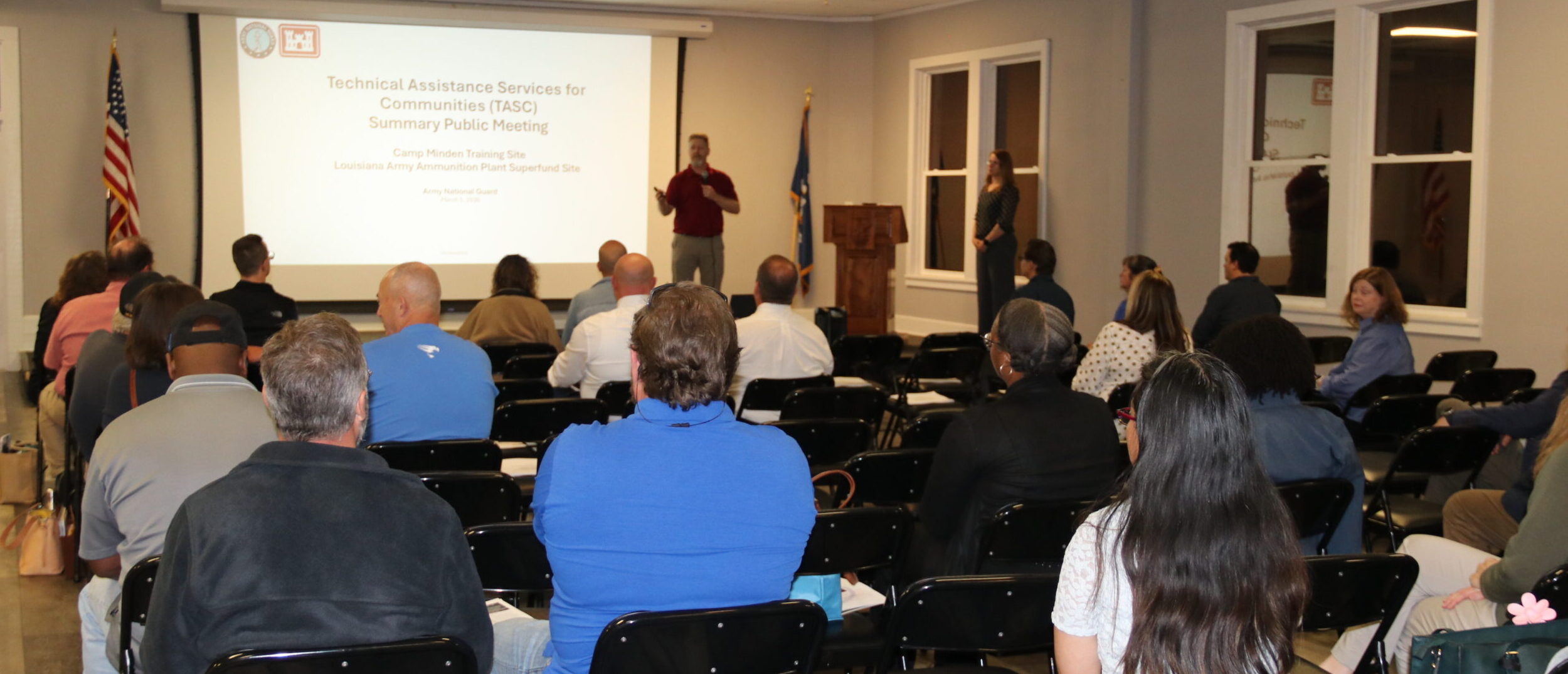
Representatives from federal and state agencies provided updates on groundwater monitoring and cleanup efforts at the Louisiana Army Ammunition Plant Superfund Site during a community meeting held Thursday, March 5, at the Camp Minden Training Center.
The meeting was hosted by the U.S. Environmental Protection Agency in cooperation with the Louisiana Department of Environmental Quality, the Army National Guard, and the Louisiana State Military Department. EPA’s Technical Assistance Services for Communities contractor, SKEO, also presented findings related to groundwater contamination and monitoring both on and around Camp Minden.
Amanda Sullivan with the Army National Guard opened the presentation by outlining several environmental studies conducted at the site, with final reports released between March 2024 and April 2025. The studies included groundwater monitoring, surface water evaluations, and drinking water assessments.

Additional work conducted between October 2025 and February 2026 included further studies of off-post drinking water and surface water, an expanded remedial investigation of the former pistol range, and soil sampling.
“We are committed to a continuous cycle of testing, monitoring, and acting on those results,” Sullivan said.
Sullivan said the monitoring effort includes extensive sampling from monitoring wells, supply wells, private wells, and surface water locations on and off the installation.
“This extensive sampling is how we get a clear and accurate picture of the environmental conditions, and it is the foundation for our entire program,” she said.
Officials have been tracking contaminant plumes of tetrachloroethylene, commonly referred to as PCE, and Royal Demolition Explosive, or RDX. Results from off-post drinking water sampling conducted in 2025 found no unacceptable risk related to volatile organic compounds or explosives. Officials reported no exceedances of screening levels, and only one well showed detectable levels of explosives or volatile organic compounds.
“This is excellent news and confirms the safety of the drinking water in the sample locations,” Sullivan said.
Testing for perchlorate and 1,4-dioxane also found no unacceptable risk and no exceedances of screening levels. Two wells showed detectable perchlorate, while 1,4-dioxane was not detected using updated testing methods.
Residents who wish to have their private wells tested can download the Private Water Well Testing brochure at www.ldh.la.gov/PWI or call 1 (888) 293-7020.
Sullivan noted that some recently completed studies were not included in the information presented by Technical Assistance Services for Communities.
“Our goal is to ensure that everyone, including our partner agencies and especially the public, has the most current and complete data,” she said.
Karmen King, representing Technical Assistance Services for Communities, presented a summary of historical groundwater contaminants at the site. The organization was tasked in 2020 with researching whether groundwater contaminants existed that were not currently being monitored.
The review involved compiling a list of groundwater chemicals of concern, documenting the highest detected concentrations by area, identifying any geographic movement of contaminants, and listing groundwater concentrations of those chemicals found beyond the Camp Minden perimeter.
King also provided historical background on the site. The federal government acquired the property in 1941, and ammunition production began in 1942. Environmental investigations started in the 1960s, and the site was added to the EPA’s National Priorities List for Superfund cleanup in 1989. Ammunition production ended in 1994, and the property was transferred to the state and renamed Camp Minden in 2005.
Federal law requires Superfund sites to undergo a review every five years when certain substances remain above specified levels. The cleanup process includes site assessment, characterization and proposed plans, remedy selection, and cleanup implementation. The five-year review then evaluates the effectiveness of the selected remedy.
“We’re well into the post-construction and clean-up phase for Camp Minden,” King said.
King said improvements in sampling and chemical analysis have significantly enhanced monitoring efforts over time.
She added that investigators have a thorough understanding of the primary areas of concern on the installation. For some contaminants, the cleanup strategy involves monitored natural recovery, allowing environmental processes to break contaminants down into less harmful compounds.
“Now, from a community standpoint, I know that doesn’t sound great, but what we have truly found is that the best engineer out there for dealing with contamination is the environment,” King said.
One finding in the Technical Assistance Services for Communities final report identified potential public concerns, including that dioxins do not appear to have been analyzed in groundwater samples on the site or in off-post areas. Dioxins can be associated with combustion processes such as waste incineration or burning fuels. The report also noted that the presence of PFAS, often referred to as “forever chemicals,” has not been fully characterized at the site.
Army National Guard representatives said risk screening is ongoing and that EPA risk values are updated every six months.
During a question-and-answer session, officials addressed concerns about possible dioxins associated with a burn chamber previously used at the site. Officials said the chamber was designed to avoid releasing dioxins, and testing conducted before and after controlled burns did not identify dioxins as a concern.
King said dioxins are rare and typically do not occur in significant quantities. Army National Guard officials added that dioxins were not part of the current investigation because the program being discussed is a state program rather than a federal investigation. Walt Gee of the Army National Guard said the compound could be added to future investigations.
The Army plans to begin PFAS sampling on the installation in 2026. The next five-year review report for the site is scheduled for release in July 2026.
Documents related to the site are available at the Doyline Library. Questions may be directed to Walt Gee at [email protected].
Officials said additional community meetings will be scheduled in the future.