

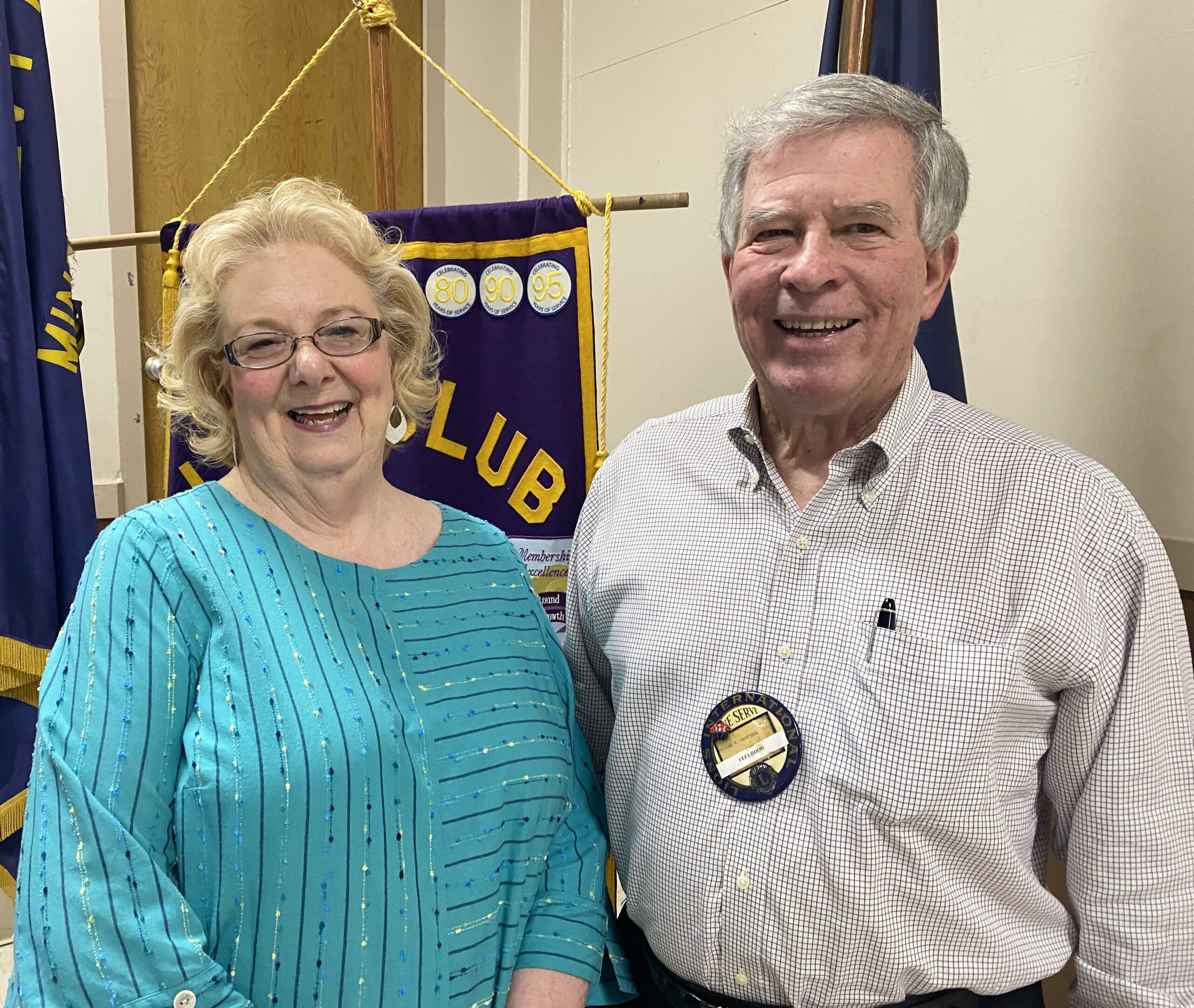
The story of a Mt. Lebanon native who flew hundreds of combat missions during World War II was the focus of a presentation Thursday, March 5, during the noon meeting of the Lions Club.
Mary Claire Kettler, a board member of the Mt. Lebanon Historical Society, introduced her new book, “Born to Fly,” which recounts the life and military service of Major Warren Waugh Sutton. Kettler said the project began when one of Sutton’s cousins asked her to research enough information for a segment on Rick Rowe’s “Hometown Patriot.”
She not only found enough for the segment, she found enough to fill a small book.

The television segment is scheduled to air March 6.
Kettler said her interest in Sutton’s story dates back to her childhood, when she noticed his name on a plaque honoring three local men who died in World War II.
“The thing that caught my eye was Burma,” Kettler said. “That just seemed like some exotic, faraway place.”
Sutton was born in 1920 to Henry and Mary Sutton and grew up in Mt. Lebanon.
“He was, pretty much, the darling of the community,” Kettler said.
He graduated from Gibsland High School and enrolled at Louisiana Tech in 1936. However, after a trip to Oklahoma at age 16, Sutton developed a passion for aviation.
“He came back and went to Louisiana Tech for a year, but that just was not for him,” Kettler said.
Sutton returned to Oklahoma, where he worked in sales while continuing to develop his flying skills.
In 1941, Sutton attempted to join the United States Air Force but was told he needed two years of college. Instead, he enlisted in the Royal Canadian Air Force, an unusual path for an American at the time.
He graduated and was commissioned in October 1941, finishing second in a class of 35. His initial training took place on Prince Edward Island in the Tiger Moth aircraft. After spending time in the frigid northern climate, Sutton volunteered for assignment in Malta.
While serving there, he flew more than 120 combat missions and was awarded the Distinguished Flying Cross of Great Britain, which was presented by King George VI in 1943.
Sutton transferred to the United States Army Air Forces on March 17, 1943, and was assigned to the 12th Bomber Group, known as the “Earthquakers” of North Africa. The unit earned the nickname for its bombing runs, in which formations of 18 B-25 aircraft would drop bombs in coordinated attacks that devastated their targets.
By 1943, the unit was operating in Italy, though rumors circulated that the group might later be deployed to Japan. By that time, Sutton had risen to the rank of major.
Up to that point, their missions typically involved high-level reconnaissance and bombing runs. However, operations in the Pacific theater often required low-level flight during combat missions.
“On the morning of August 1944, it was probably just another day for Warren,” Kettler said. “He had his orders which were to bomb railroad tracks in Burma. This was his 199th combat mission. This was his last day.”
Three planes flew the mission that day. One of Sutton’s wingmen later reported that after the bombs were dropped, the aircraft returned to the railroad bridge target area. The wingman said he saw a B-25 aircraft going down with its right engine on fire before it exploded upon impact with the ground.
A memorial service for Sutton was held in Mt. Lebanon in 1946. In 1949, remains recovered from the war zone were interred in a mass grave at Arlington Memorial Cemetery.
“He was awarded the Distinguished Flying Cross by two countries, had served in two Air Forces, had fought all three Axis powers, and was gone at the age of 24, leaving his Mary, his mother, a Gold Star Mother,” Kettler said.
Kettler noted that details surrounding Sutton’s final mission were not declassified until 29 years after the war.
“So, today, I probably know more about what happened to Warren than his mother ever knew, because these records were not released until 1973,” she said.
The Lions Club hosts speakers each Thursday at its noon meetings at the American Legion Memorial Hall, 119 Pine St., in Minden. The organization welcomes new members who share its community service mission, reflected in its motto, “We Serve.”