


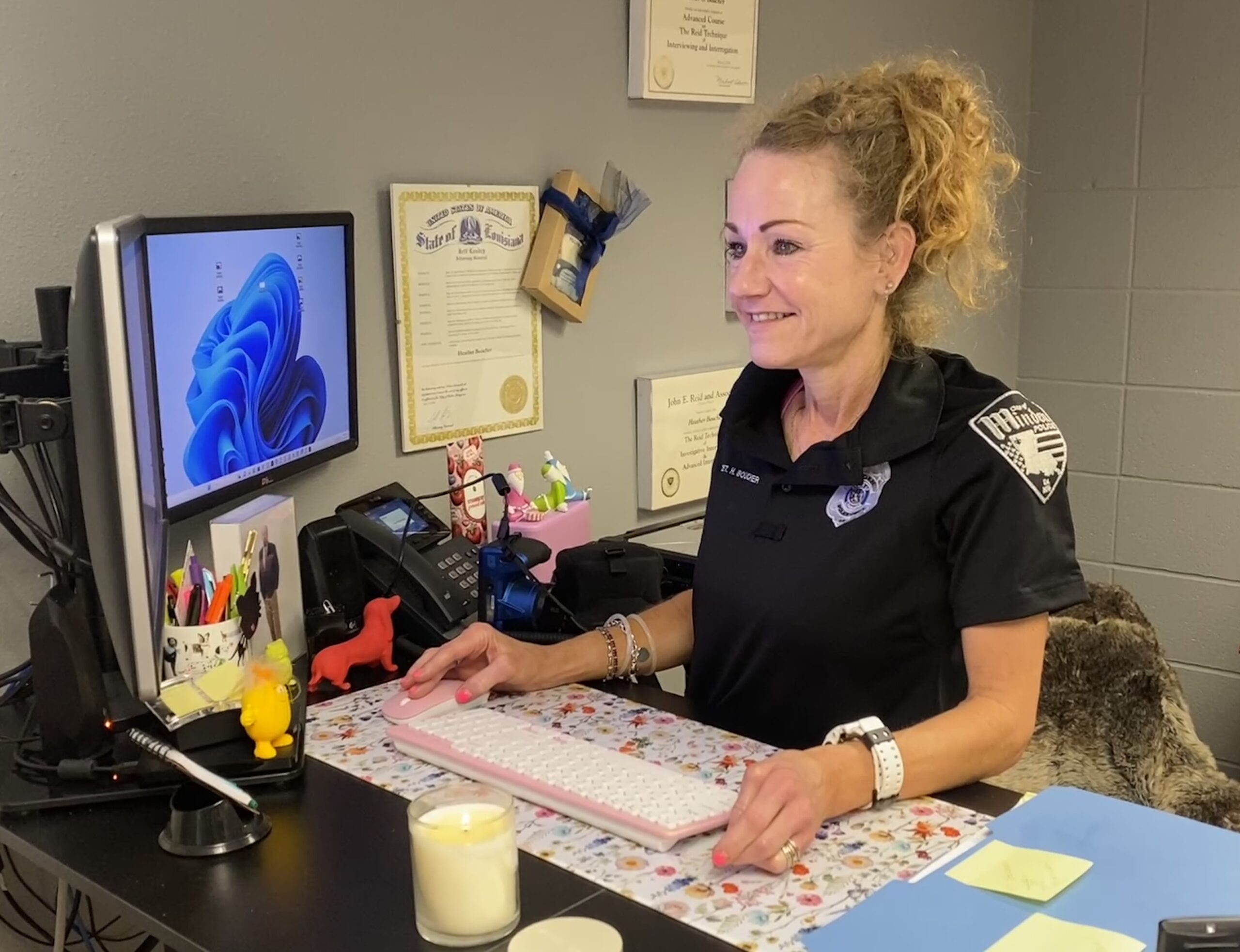
Detective Heather Boucher has spent much of her career investigating some of the most difficult crimes law enforcement encounters. Now, as Minden Police Department’s newest detective, she hopes to pair years of investigative experience with education and outreach to help victims feel heard — and encourage more people to come forward.
“I love what I do,” Boucher said.
Boucher joins the department after working with the Shreveport Police Department, the Webster Parish Sheriff’s Office, and as a campus investigator at Centenary College. Along the way, she developed a passion not only for investigating sex crimes and crimes against children, but also for preventing them through education.

Before entering law enforcement, Boucher worked in the beauty industry doing nails. She said she had always wanted to work in investigations involving sex crimes and crimes against children, eventually taking the leap into law enforcement with the Shreveport Police Department.
“I went to SPD and got amazing training in the field because, well, you’re always busy,” she said.
After her time in Shreveport, Boucher accepted a position as an investigator at Centenary College, where she handled investigations while also leading educational programs focused on sexual assault awareness, domestic violence prevention, internet safety, and related topics.
“We did a lot of education, and I found another love,” she said. “I love to teach and educate on prevention and awareness, not just on sexual assault but on domestic violence, safety on the internet, anything that can provide a better life for others.”
Although she hated leaving Centenary, Boucher said the Webster Parish Sheriff’s Office offered her the opportunity to focus exclusively on sex crimes, something she had long hoped to do. Later, believing she had checked off a career “bucket list” item, she transitioned into the private sector after turning 50, working in law enforcement-related sales and later as a licensed private investigator for international security firms.
Still, something was missing.
“I just kept missing law enforcement,” she said.
That desire ultimately led her to Minden.
Though originally from Texas, Boucher has lived in the Shreveport area since high school. She said she and her husband, a Webster Parish native, had long appreciated the community.
“I went to work for the Sheriff’s Office and just fell in love with the town and the people and the parish,” she said.
Since joining the Minden Police Department, she said she has felt immediately welcomed.
“The people here have been just so kind and inviting,” she said. “I walked in and it was like home. Good people here. Very good people.”
A personal mission
Boucher said her passion for investigating sex crimes is rooted in her own experiences as both a child and young adult.
“My own personal experience as a child and a young adult,” she said when asked what drew her to the field. “I want to be a voice for the voiceless.”
She described having a negative experience with law enforcement after her own abuse and said it motivated her to become the kind of investigator she wished she had encountered.
“Just knowing what I went through, and I didn’t have a good experience with law enforcement, at all. It was a terrible experience,” she said. “I wanted to be different. I wanted to make people feel safe.”
Victims often experience a flood of emotions, she said, including fear, anger, confusion, denial, and self-doubt.
“You’re uncomfortable to begin with: you’re hurt, you’re scared, you’re mad,” she said. “I think you have every emotion going on, and you’re also in denial. You don’t want to believe this has happened. You start to second guess yourself.”
She said victim blaming remains one of the greatest barriers to reporting abuse.
“Victim blaming is huge,” she said. “There are so many reasons people don’t come forward. Some people don’t understand that, but I get it. One hundred percent I get it.”
Parents, she said, can also struggle to accept that abuse has occurred.
“They don’t want to believe this has happened,” she said. “But the key, whether a child or adult, is if they’re listened to and they’re heard and they’re believed the healing begins.”
Understanding the signs
Unlike many other crimes, Boucher said sexual abuse and domestic violence often involve someone the victim knows and trusts.
“When it comes to sex crimes or domestic abuse … it hits at a different level because the violation is typically done by someone who is supposed to have loved them,” she said.
Many offenders convince victims that abusive behavior is actually an expression of love, she said.
Boucher encourages parents to pay attention when something seems different in their child’s behavior.
“Most people know when something is off with their kid,” she said. “Investigate what is off in their life. It might be something very minute or it might not.”
She emphasized that changes in behavior are not automatic signs of abuse but should prompt parents to learn what is happening.
“If they stop wanting to go to a place that they always loved, that could be a sign,” she said.
Drawing from her own childhood, Boucher recalled no longer wanting hugs from any man, not even her father.
“That was a clue that should have been investigated,” she said.
Other behavioral changes, including altered eating habits, can also indicate a child needs help. Boucher noted that research has shown victims who are not heard or believed are statistically more likely to develop eating disorders, substance abuse problems, and other long-term issues.
Misconceptions and technology
Among the biggest misconceptions surrounding sexual assault, Boucher said, is the belief that offenders are usually strangers.
She also pointed to another misconception.
“That it doesn’t happen to boys,” she said. “It happens to young men all the time, but it goes unreported because of the stigma. There’s a stigma on reporting sexual assault in general, but when you add being a male, it is terrible.”
Technology has also changed both investigations and the crimes themselves.
“It’s helped investigation 100%, especially with retrieving data,” she said. “I love that technology helps law enforcement, but it’s also created lots of crimes.”
She noted that offenders no longer have to meet victims face-to-face for crimes to occur.
What families should do
Boucher said one of the biggest mistakes well-meaning adults make is questioning a child before trained professionals can conduct a forensic interview.
“The biggest mistake: Talking to the child. Listening to the child is what we need to do. We don’t need to talk to the children, and there’s a difference,” she said.
Specially trained forensic interviewers know how to allow children to tell their stories while gathering information in a way that preserves the integrity of an investigation, she said.
“Listening doesn’t mean you have to believe, but just listen to the child, the victim, and allow them to report,” she said. “Let law enforcement do the job of the investigation on whether there’s enough for a DA to prosecute. Let the process work.”
Parents should reassure children they are safe, she said, while understanding that some children may not want physical comfort after trauma.
“If parents get anything out of this, just listen and get them resources,” she said.
Anyone who suspects abuse or is unsure whether a crime has occurred should contact law enforcement.
“We’re here 24/7,” she said.
Looking ahead
Beyond investigations, Boucher hopes to host community forums where residents can ask questions and learn more about recognizing abuse, protecting themselves online, and available resources.
Asked about online dating, she did not hesitate.
“I hate it,” she said.
For those who choose to meet someone they first encountered online, Boucher recommends meeting in a busy public place, driving separately, letting a trusted friend know when they arrive and leave, and asking a manager or employee to escort them to their vehicle if they begin feeling unsafe.
Ultimately, Boucher said success in her new position would mean building trust within the community.
While eliminating sex crimes altogether would be ideal, she knows that is unlikely.
Instead, she hopes people will feel comfortable reaching out.
When asked what she wants someone to know after walking into her office following the worst experience of their life, her answer was simple.
“That I’m here to listen, and I’m here to fight for them and for their voice to be heard.”
Boucher can be reached by email at [email protected] or by calling the Minden Police Department. Information about victim services is available through the Northwest Louisiana Family Justice Center. For a list of resources, visit nwlafamilyjusticecenter.org/resources.