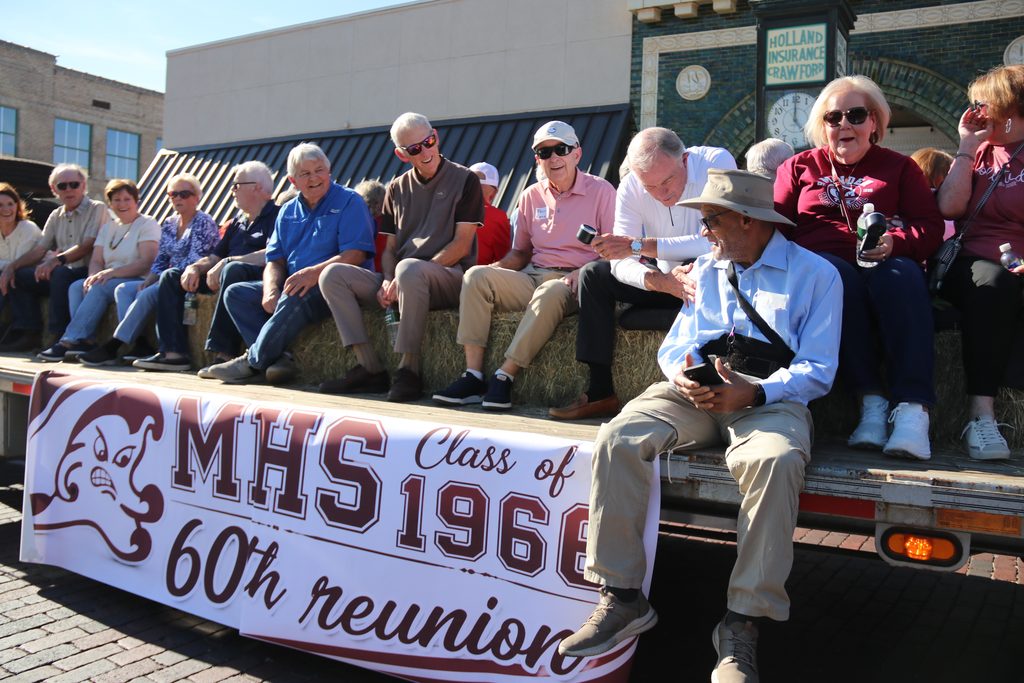

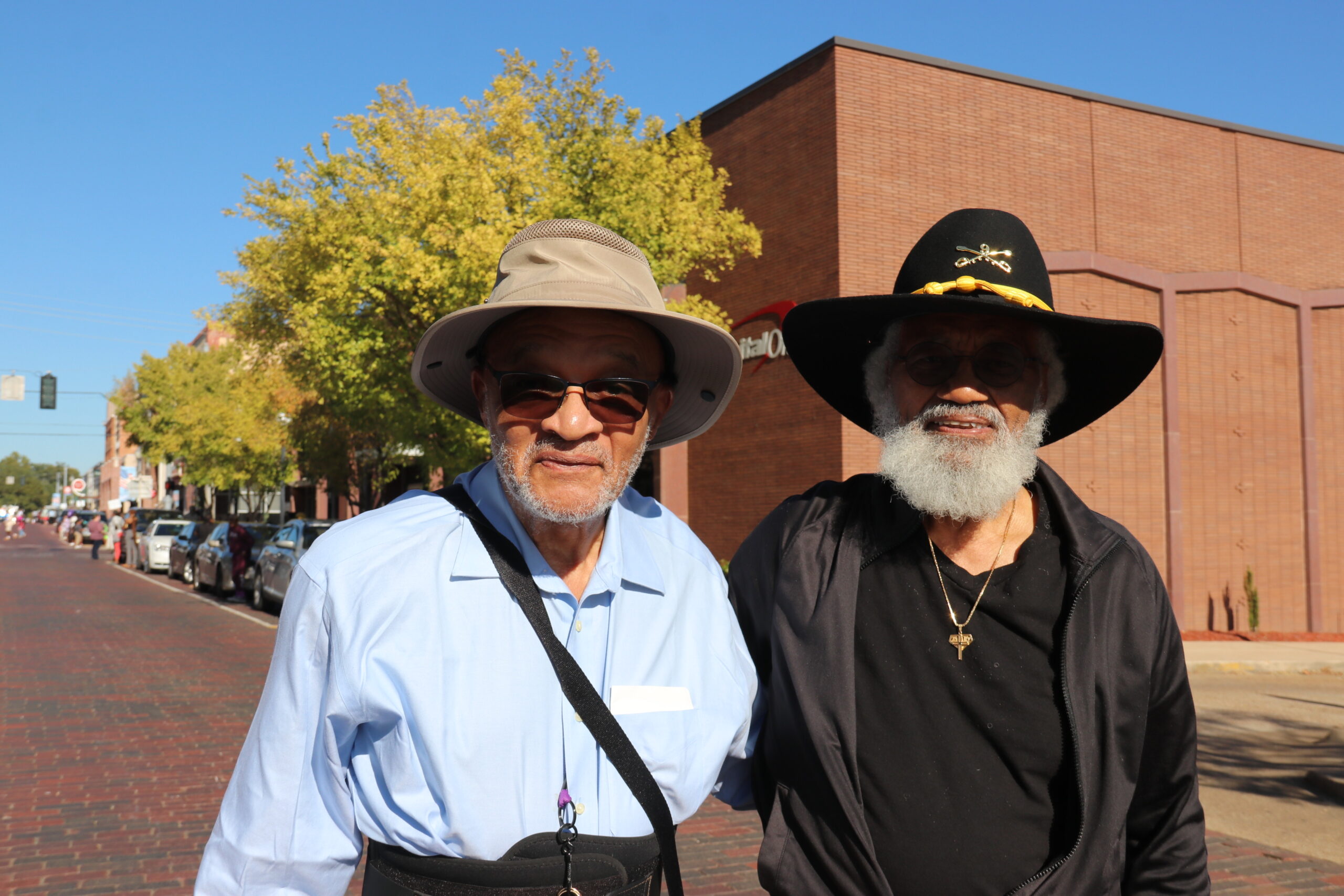
When Roy Allums returned to Minden for Minden High School’s homecoming celebration Friday, October 23, he joined fellow members of the Class of 1966 in celebrating their 60th reunion. For Allums, however, the occasion marked more than six decades since graduation. It was a return to the school where he made history as its first Black graduate.
In January 1966, Allums and his cousin, George Washington Jr., became the first two Black students to attend Minden High School as the school system began desegregating. Washington, then a junior, returned to Webster High School the following year to graduate. Allums, a senior, remained at Minden High and received his diploma that spring.
At the time, Allums said, he had little understanding of the historical significance of what he was doing.

“No. I felt like it was something that needed to be done,” he said during a recent telephone interview. “In fact, it’s only in the past 10 or 12 years that I realized the significance of it. Somebody had to do it, and so I did it, not realizing the significance of it.”
A family involved in change
Allums grew up in a large family already deeply involved in the civil rights movement. His parents participated in efforts to challenge segregation and discriminatory voting practices, and his mother traveled to New Orleans to testify in federal court about voting rights.
“There were a lot of civil rights activities going on back then, and my family was in the thick of it,” Allums said. “Our parents saw things we didn’t see because we were kids.”
His path to Minden High School began somewhat unexpectedly during the spring of 1965, when his older sister Fae was preparing to graduate from Webster High School.
Fae’s classmates wanted to celebrate their senior year with an outing to Caney Lakes. Although Black residents could fish there, Allums recalled that they were prohibited from using certain recreational facilities, including areas designated for swimming and picnicking.
His father owned a large truck, and Allums transported a group of students to the lakes. Several juniors, including some of his own classmates, joined the outing without permission from school officials.
When Webster High School Principal Mr. Hayes learned that students were missing, teachers were sent to locate them.
The following morning, Hayes met Allums as he stepped off the school bus. The two spent much of the day together, discussing the incident and the restrictions placed on Black residents.
By the end of the day, Hayes challenged Allums about his willingness to continue attending a segregated school.
“He said, ‘I’ll give you an application. You can apply to go to school up there with the white people then.’ I said, ‘Give it to me,'” Allums recalled.
Allums took the application home and told his mother what had happened. Looking back, he believes the principal knew exactly what he was doing.
“I later discovered they had used reverse psychology on me,” he said.
Legal challenges to segregation were already underway. Allums recalled the work of Shreveport attorney Jesse Stone in pursuing school desegregation and said the resulting process began with selected grade levels, including first and second grades, and 11th and 12th grades.
His youngest sister entered first grade as he began his senior year at Minden High. His cousin, George Washington Jr., joined him at the high school.
A difficult senior year
Allums entered Minden High School in January 1966, midway through his senior year.
Although he encountered hostility, he also remembers teachers and students who treated him fairly.
One of his most disturbing memories involves returning from a school break and discovering a dead black cat inside his locker.
“It didn’t faze me one bit,” he recalled. “It smelled bad, but I reached in, took my books out, and went on to class with these stinking books.”
Within minutes, the principal appeared in his classroom, removed him from class, and arranged for the locker to be cleaned and his books replaced. Allums said the principal apologized.
Another incident occurred during a lunch break when a male student threw an open switchblade knife toward him.
Allums said he sidestepped the knife, which struck a nearby tree. He picked it up, slid it back toward the student, and challenged him to try again.
Unbeknownst to Allums, the principal had witnessed the incident. He confiscated the knife and escorted the other student into his office.
“I think perhaps I was too dumb to be afraid,” Allums said. “When I got older, I realized kids do stupid stuff. But I had no fear.”
In shop class, someone deliberately damaged a piece of furniture Allums was making by pouring paint onto it. He recalled that the instructor, whom he remembers as one of the school’s coaches, became angry and reprimanded the entire class.
“He was one of the few people who stood up for me in that class that day,” Allums said.
He also remembers a teacher who replaced his original homeroom teacher and treated him kindly.
Although he encountered some friendly classmates, Allums said many were reluctant to associate with him openly.
“I think a lot of the kids were nice people. They were just afraid to speak up or stand by me,” he said.
“There were a few nice people around the school. They were decent people, but reluctant to hang out with me. So I was alone there for the most part, except for a handful of hecklers.”
The cost of integration
The consequences of desegregation extended beyond the classroom.
Allums’ father had operated a freight distribution business under contract with the railroad for years, unloading shipments arriving in Minden and delivering goods throughout the area.
According to Allums, the railroad canceled his father’s contract after he enrolled at Minden High School.
“When I integrated the school, the railroad canceled his contract,” Allums said. “They took his contract.”
With a large family to support, his father eventually found work at Evergreen, a school north of Minden that operated agricultural facilities, including a dairy.
Allums also recalled two occasions when gunfire struck the family’s home.
During the first shooting, he said, the family was awakened around midnight by gunfire. His parents ordered everyone onto the floor.
Allums grabbed a rifle and headed toward the back door, but his mother stopped him.
“She said, ‘No, you’re not going out. You’re not going out,'” he recalled.
Fearing he might confront the attackers, his parents sent him to stay with siblings in Ohio.
A second shooting occurred while he was away. Allums said members of the Deacons for Defense and Justice, an armed civil rights organization, subsequently helped protect the family’s home.
He also recalled learning that he had been the intended target of a separate shooting in downtown Minden in which another man was killed. According to Allums, the shooter reportedly mistook the victim for him because of a similar cap.
Despite the threats, Allums completed his senior year.
Graduation night brought another reminder of the tensions surrounding his enrollment.
Allums said he learned afterward that local media outlets had received threats against his life if he attended the ceremony. He recalled that FBI agents informed him of the threats after graduation.
He also noticed that while the other graduates were arranged in alternating boy-girl order, two boys were placed ahead of him and two behind him.
Still, he walked across the stage and received his diploma, becoming Minden High School’s first Black graduate.
A life beyond Minden
Following graduation, Allums planned to attend Southern University in Baton Rouge, but another family emergency delayed his education.
His father suffered severe burns in an explosion at Evergreen while helping two boys escape from a building near the dairy facilities. Both boys later died, according to Allums. While no arrests were ever made, Allums reported that the FBI said that the explosion had been “set.”
His father survived, but the injuries left him unable to work for a time. As the oldest son still at home, Allums decided to remain in Minden to help support the family.
His parents, however, had other plans.
The following fall, after classes at Southern University had already been underway for about a month, they returned home from town with clothes for him and announced that he would be leaving that night.
They had contacted his former principal, arranged his enrollment, and made plans for someone to meet him at the train station in Baton Rouge.
“That’s how I went to Southern University,” Allums said. “I had already decided I wasn’t going to school.”
At Southern, he studied agriculture and animal science. A research paper he wrote was presented at a meeting of the American Dairy Science Association, attracting the attention of scientists at the Beltsville Agricultural Research Center in Maryland.
An invitation to work there during the summer helped launch a career in scientific research.
Allums later worked for a milking-equipment manufacturer in Wisconsin, developing scientific testing procedures to evaluate equipment performance and address concerns about the spread of mastitis among dairy cattle.
His career eventually shifted from animal science to information technology and telecommunications.
He managed IT operations supporting the U.S. secretary of agriculture, overseeing more than 50 employees involved in networking, software development, programming, and technical support.
After a spinal injury in 2000 prevented him from returning to his previous duties, he moved into emergency telecommunications.
In that role, he represented the Department of Agriculture in an interagency federal group responsible for telecommunications policy and emergency response.
Allums said his responsibilities included coordinating teams that restored communications following natural and man-made disasters. After the devastating 2010 earthquake in Haiti, he dispatched a team to assist with establishing communications in affected areas.
Despite the breadth of his career, Allums said his education at Southern University provided a foundation that served him well.
“Working at Beltsville taught me that my education at Southern University was broader than I’d realized,” he said.
Remembering the sacrifices
Now, 60 years after his graduation, Allums views his experiences differently than he did as a teenager.
He said it was not until he reached his 70s that he began reflecting seriously on the dangers he had faced and the sacrifices his family made.
His parents’ determination, he believes, was essential to his success.
“The sacrifice. I didn’t know it was a sacrifice at the time,” Allums said when asked what he hoped today’s Minden High School students would understand about that period.
“People don’t understand the sacrifice that some people go through. We had a lot of kids in our family. My parents sacrificed everything to make this happen. When you’ve got a lot of mouths to feed, that’s something.”
He hopes younger generations will learn about the struggles that made opportunities available to them today.
“They need to understand what happened to get us where we are today,” he said. “The people who died, Martin Luther King died. A lot of people died trying to get us to this point.”
Allums has maintained some connections with former classmates and relatives in Minden over the years. His family has held regular reunions, and he has kept up with activities involving Webster High School alumni.
He also hopes to locate his original graduation portrait, taken before he transferred from Webster High School to Minden High. Because he enrolled in January, his photograph was never included among the graduating class portraits displayed at Minden High School.
He would like to see that omission corrected.
On Friday, Allums returned to the streets of downtown Minden, joining classmates from 1966 on a float during the school’s homecoming parade.
Six decades earlier, he had entered Minden High School as one of only two Black students, uncertain of what awaited him and unaware of the place he would hold in the school’s history.
This time, he returned as a member of a graduating class celebrating 60 years of shared history.
For Allums, the most important lesson is not simply that he was the first, but that the opportunities available to later generations came through the sacrifices of those who preceded them.
“If I can get these young folks to understand how we got where we are, maybe we’d have a better world,” he said.