



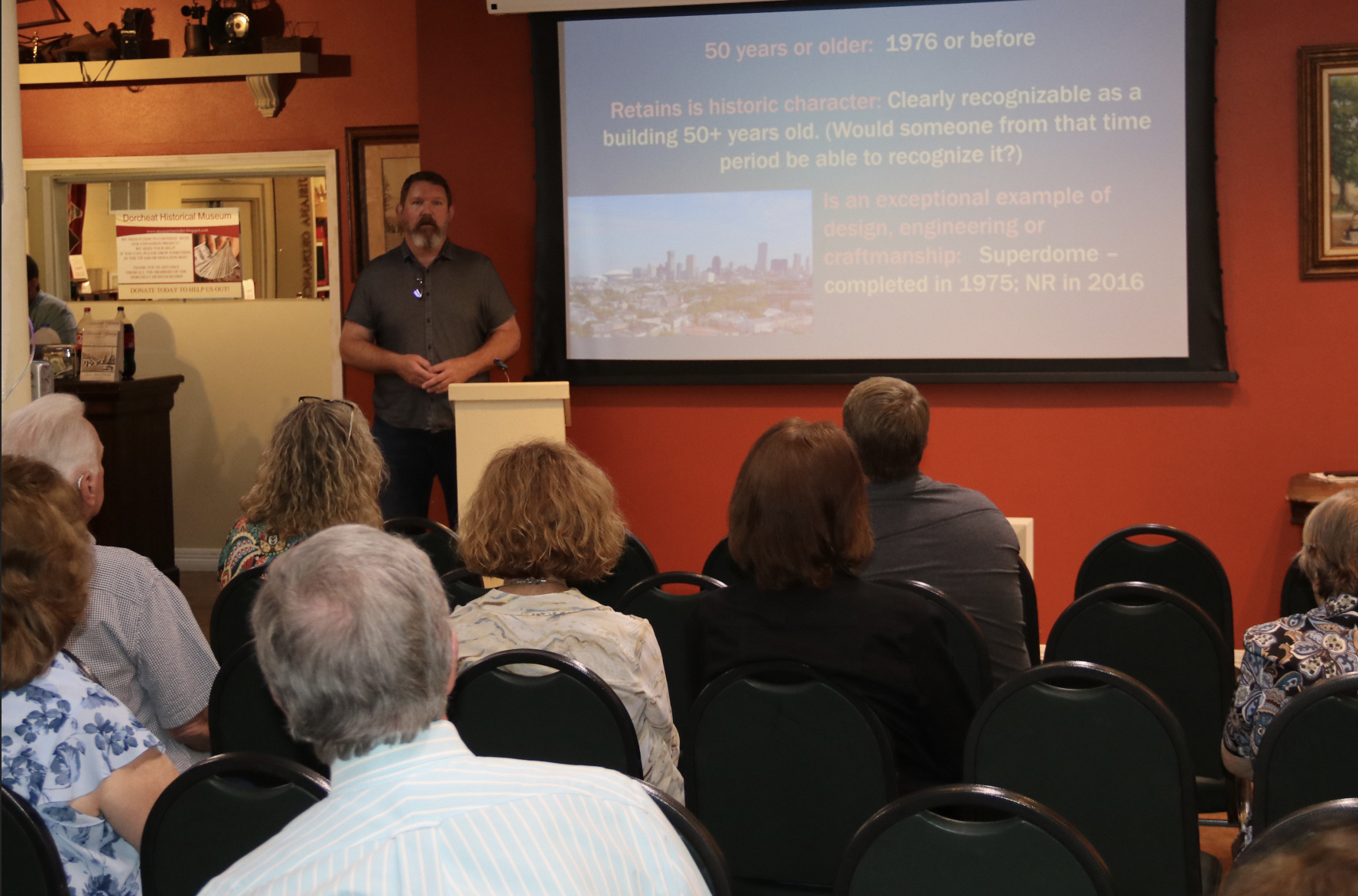
Historic preservation efforts across Louisiana were the focus of a March 9 presentation at the Dorcheat Historical Museum, where Brian Davis, executive director of the Louisiana Trust for Historic Preservation, spoke during the museum’s monthly Night at the Museum program.
Davis leads the Louisiana Trust for Historic Preservation, a statewide nonprofit that works to connect owners of historic buildings with financial resources, research, and preservation programs.
“It’s our job to help connect the historic buildings and owners with the resources that are out there,” Davis said.

Those resources may include historic tax credits, preservation easements, research on comparable restoration projects, and educational programs. The organization works in all 64 parishes and partners closely with the state agency Louisiana Department of Culture, Recreation, and Tourism.
Davis said the organization was founded after the demolition of an 1835 home in 1979. The historic structure was bulldozed overnight to make way for an oil tank farm, but the project was never built. At the time, historic preservation efforts in Baton Rouge did not have statewide jurisdiction, prompting advocates to establish a nonprofit dedicated to protecting historic sites throughout Louisiana.
The National Register of Historic Places, Davis said, recognizes buildings worthy of preservation but does not prevent demolition.
“Where your protection actually comes from is your local historic district and your review commission,” he said. “That’s where your local protection comes from.”
Generally, buildings that are at least 50 years old and retain their historic character may qualify as historic.
One of the main tools used to preserve such structures is historic tax credits. Davis said state credits can cover 25 percent of eligible rehabilitation expenses in cities and 35 percent in rural areas. Federal credits can cover up to 20 percent of qualifying costs. These incentives apply only to income-producing properties. A residential tax credit previously available in Louisiana expired in 2017.
The Trust also operates a Revolving Fund real estate program launched about a decade ago. Through the program, the organization acquires historic buildings through donation or purchase, rehabilitates them, and resells them with preservation easements that protect their historic character.
A preservation easement is a voluntary legal agreement recorded with a property’s deed that restricts future alterations, development, or demolition in order to protect a historic structure.
“We’ve had a number of families who have donated easements on their properties to us,” Davis said.
Two buildings on the courthouse square in nearby Homer are currently part of the program. Davis said about $70,000 was invested to install new roofs and stabilize the exteriors.
“We have those listed for sale right now,” he said. “Both of these are eligible for those tax credits, so if someone bought them they could save 55 percent of the reup costs in getting them operational again.”
The Trust also conducts educational seminars, workshops, and tours. Past programs have included a cemetery cleaning workshop at the Homer Cemetery.
Another major effort is the organization’s Rosenwald School inventory project. For the past six years, the Trust has been working to identify surviving examples of Rosenwald Schools in Louisiana. More than 5,000 schools, shops, and teacher homes were built for African American students in the segregated South between 1917 and 1932 with funding from Julius Rosenwald, president of Sears, Roebuck & Company, in partnership with Booker T. Washington of the Tuskegee Institute.
Davis said Webster Parish once had 28 Rosenwald Schools, the fourth-highest number of any parish in the state.
Researchers use archives from Fisk University along with historic maps, satellite imagery, and newspaper records to locate potential sites before verifying them in the field.
“At this point, 95 percent of the Louisiana Rosenwalds have been mapped,” Davis said. “I’ve got about another 20 or 21 still left to try to figure out where they are.”
He said a well-preserved example can be found in the community of Mount Olive.
“The desks are still there, the chalkboards are there; it’s really like walking back in time,” Davis said. “It’s because Mount Olive Church has maintained this since it has no longer been a school. It’s really a treasure.”
When the project began, four Rosenwald sites in Louisiana were listed on the National Register of Historic Places. Researchers have since identified 19 standing schools and one teacher residence in the state.
Additional programs highlighted by Davis included the Trust’s Most Endangered Places list, which has documented more than 200 threatened historic sites since 1999, and the Louisiana Registry of Historic Cemeteries, launched about a year ago.
The cemetery registry currently includes about 8,000 mapped cemetery locations across Louisiana. Sites may qualify if the first burial occurred at least 50 years ago, if the cemetery contains a person of social importance, or if it includes architecturally significant structures.
“Cemeteries are really archives for communities,” Davis said.
The organization is also gathering historical accounts and records related to the Great Mississippi Flood of 1927 as part of a centennial project examining the disaster’s impact on the Delta region. The effort includes a digital archive, public meetings, and sculptural markers created by artist Joel Breaux showing flood depths at various locations.
Davis said preservation efforts are important to maintaining the identity of communities.
“These historic buildings are the fingerprints of our communities,” he said. “When you see a historic building … you know exactly where you are because there are no two places just like that.”
Funding for the Trust comes primarily from events and memberships. The organization also provides free property listings for buildings that are at least 50 years old.
More information about the group’s programs and memberships is available at lthp.org.
The next Night at the Museum program will be held April 13 at the Dorcheat Historical Museum, located at 116 Pearl Street in Minden. Speakers Cindy Madden and Lisa Dick will present a program on the history of E.S. Richardson.