


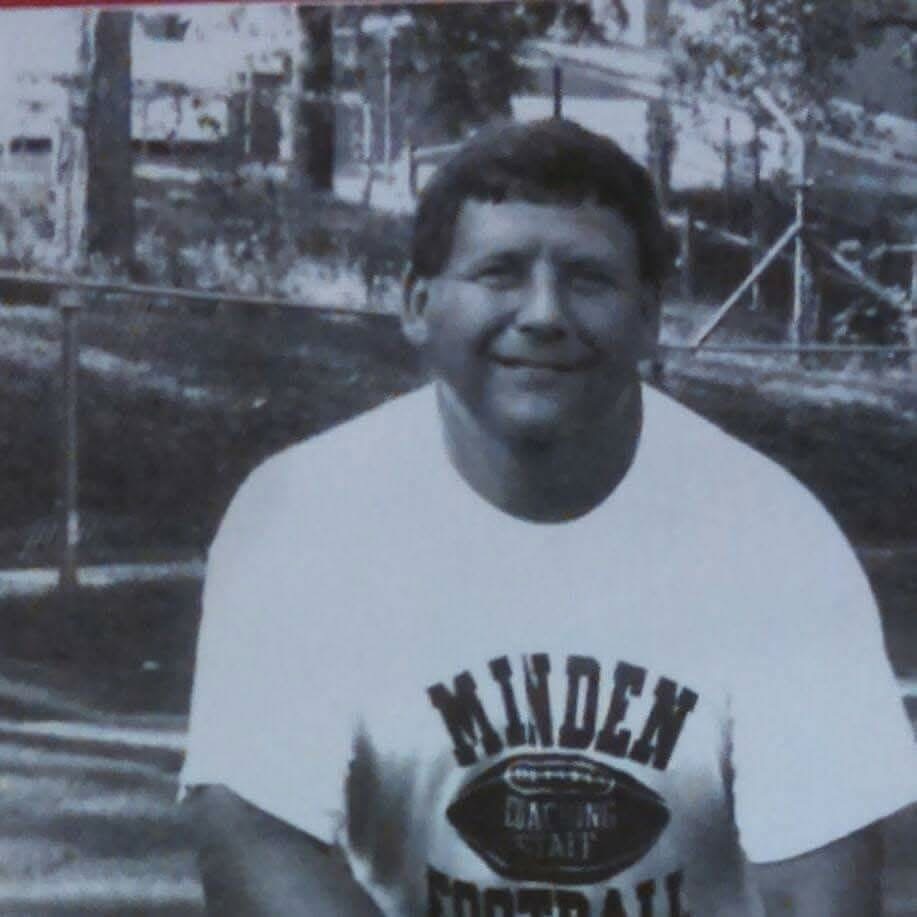
Ronnie Whatley lived a life that was “bigger than football.”
That’s how Minden boys basketball head coach Jacob Brown describes the former Minden High Head Coach.
Whatley passed away on May 5 at 79 after a long battle with health issues. Visitation and services celebrating his life will be held Saturday at First Baptist Church in Minden. Visitation starts at 10 a.m. with services scheduled for noon, according to his obituary. Officiating will be Bro. Leland Crawford. Interment will follow at Gardens of Memory in Minden.

Whatley was an educator and coach for 45 years. After a longtime stint as an assistant coach, he became the head coach at Minden from 1993 until 2003 before finishing his career at Webster Junior High.
Whatley was a standout player at El Dorado, Ark., High and played football at Northwestern State.
Brown played for Whatley during his four years at Minden High from 1995-1999. He played some receiver and quarterback his sophomore year and was the quarterback his last two seasons. Brown was also avcolleague of his at Webster Junior High for four years as he was starting his career as a coach and an educator.
“He was a great guy, a great coach,” Brown said. “Not just football. He loved track too. He’ll always have a profound impact on Minden High School athletics and the Minden community in general.”
Brown recalled Wheatley’s great sense of humor. “Lots of laughs and when it was business it was business,” he said.
Brown said Whatley was a huge influence on his life and the direction it’s taken both personally and professionally.
He recalled a time when Whatley and his staff at the time encouraged their players to see a production at First Baptist Church. Brown said he believes the title was Heaven’s Gate and Hell’s Flames. Brown wasn’t a member of First Baptist at the time but later became one as an adult.
“I grew up in the church but that was a production to where the burning desire to have a true and real relationship with Jesus Christ,” Brown said. “I was like, this is real, this is important. And coach presented that to us all while, I want to say it was during spring football.
“For me it’s one of the biggest and most important decisions you can make in life and I just remember that.”
Whatley’s impact outside of football was illustrated in a moving article in The Press-Herald in 2015, the year he retired.
The article was written by the mother of Dick Lawson, who was born in Georgia with special learning disabilities. It describes how Lawson was enrolled in Evergreen Life Services near Minden when he was 16.
His and Whatley’s lives entertwined when they met through Special Olympics.
Whatley took Lawson under his wing, became his mentor and made him a part of the team. Eventually he and his wife Cheryl began handling Lawson’s affairs after it looked like he might have to leave town after a caretaker died.
Lawson’s mother said she once asked Whatley how such a great athlete could be such a kind loving man. The following was his response.
“I was born and raised in El Dorado, Arkansas. At the age of 6 years old I was stricken with polio. I remember how it felt to watch the normal kids run and play. I swore that when I got well, I would outrun them all. El Dorado had an outstanding Boys Club run by Cecil Kellum and he taught us that athletic competition would build our character. I loved growing up in El Dorado and I hope the Minden children feel the same way about their hometown. After my playing days were over, I have found it very satisfying to give back to my teammates, family, church and community. I started out as Dick Lawson’s mentor and now he is more like my brother.”
Dick Lawson will be an honorary pallbearer at Whatley’s funeral.
Jake Chapman is another one of Whatley’s former players at Minden. He recalled his coach in a Facebook post.
“I was sad to hear of the passing of a great man, Coach Ronnie Whatley,” Chapman wrote. “I didn’t have a great appreciation for him until I was a little bit older. He spent decades molding the lives of young men and young coaches.
“I recall several times he would come into the locker room at halftime and would begin to cry while addressing the team. I, in the arrogance of my youth, foolishly mistook this for weakness. It wasn’t until later that I realized that Coach Whatley was so passionate about us (idiots) and the game of football that it moved him to tears. He wanted it badly. “He wanted us to want it as badly as he did. He often told us we ran slower than a box turtle, or his dead grandma, or a broke-legged mule. But there was no mistaking that he loved us. Always did.”
Brown said the values Whatley espoused were an extension of his value system from home.
“Saying he’s a good man is an understatement,” Brown said. “He was a great man, great to me. Pushed me, motivated me. What you needed in a coach.
“It was about hard work. It was about doing things the right way. Not that you were going to be perfect.
“But I was able to relate because the value systems matched up. It was just a revolving circle of the right expectations and in some cases it was demands.”
Brown said when he and Whatley became colleagues at Webster, they had many conversations over cups of coffee about football and life.
“God’s plan directed me back to Coach Ronnie Whatley,” Brown said. “It was one of the best things that could’ve ever happened to me just as a coach, football in particular because I was able to get back to the foundation and fundamentals. It was a catalyst for me to grow as a coach in those first four years.”
“There were things that stick with you that I implement within my basketball program. Coach Whatley set a foundation for me. It relates to what I do every day.”
Brown has always remained in contact with Whatley. They had been planning to get together this past year for one of their talks over coffee. But life got in the way and they weren’t able to.
However, during the last month of this past baseball season, Whatley attended a game. They were able to sit together, watch baseball and talk.
In what Brown believes must have been just hours before his death, Whatley sent Brown a message congratulating him and his family on the success of his older son Hudson, a multi-sport athlete who is continuing his baseball career at Southern Arkansas.
“That’s a relationship I’ll always cherish,” Brown said.